Glossary
Terms commonly used in traditional Japanese music composition and performance.
| Ai-no-te | 合の手, 合手, or 合 | Brief instrumental interlude within a vocal section (Mae-uta, Naka-uta, Ato-uta). | |
| Arui wa | 或 | Alternate version | |
| Arui wa nashi | 或無 | Not played in some versions | |
| Atari | 当り | To strike a finger hole | |
| Ato-Uta | 後唄 | Ending vocal section | |
| Chikuzen inchinyo | 竹禅一如 | The bamboo and Zen are as one | |
| Chirashi | 散らし or チラシ | Transitional section, usually between Tegoto and Ato-uta. | |
| Dai Kan | 大甲 | Third (highest) octave on the shakuhachi | |
| Danmono | 段物 | Scored in Dans (sections) without vocals | |
| Dojikyoku | 童子曲 | Children's song. Actually called "Dokyoku" | |
| Furi | フリ | A rapid meri/kari head dip. | |
| Gagaku | 雅楽 | Japanese Imperial Court music | |
| Gaikyoku | 外曲 | Literally, “Outside music”. Usually used by shakuhachi players to describe the music (particularly ensemble music) outside of the solo Honkyoku repertoire. | |
| Gakufu | 楽譜 | Musical notation | |
| Hachigaeshi | 鉢返 | Returning the bowl. | |
| Hate | 果て | A light kind of honkyoku. Played in the afternoon when free from strict discipline of religion. | |
| Hayai / Hayaku | 早い、早 or 早く | Faster | |
| Hōgaku | 邦楽 | Generally, music for traditional Japanese instruments. | |
| Honkyoku | 本曲 | The original music, mostly solo pieces, for shakuhachi, often called Zen music due to the traditional history of the shakuhachi’s use as a tool for meditation. | |
| Honte | 本手 | The main body of a piece. A melodic development in higher register. | |
| Ichi Ji Ichi Ritsu | 一寺一律 | One temple, one piece | |
| Ichion Jobutsu | 一音成仏 | To reach enlightenment by the use of only one sound | |
| Jiuta | 地歌 or 地唄 | Music originally written for voice and shamisen originating in the Kansai region. | |
| Kaede | 替手 | Second part to be played along with the original melody line or a secondary arrangement of a piece. | |
| Kake-ai | 掛合 | Call and response section, usually indicated by brackets (「 and 」) at the beginning and end. | |
| Kan | 甲 | Second (higher) octave on the shakuhachi | |
| Kari | カリ | Blow by putting the chin up, to raise the tone | |
| Kokyū | 胡弓 | A stringed instrument resembling a Shamisen in construction (and also having origins in Okinawa) that is played with a bow. | |
| Komi Buki | 込吹 | Pulsing breath technique. | |
| Koto | 箏 | Often referred to as “Japan’s National Instrument”, the koto is a long, horizontal multiple-stringed instrument with movable bridges that allow changes in scales and tuning, often during play. Its roots can be traced to similar instruments in both Korea and China. The standard version features 13 or 17 strings, but 25+ stringed versions have been available since the early 20th Century. | |
| Kumiuta | 組歌 | Pieces for Koto license | |
| Mae-Uta | 前唄 | Opening vocal section | |
| Meri | メリ | Blow by putting the chin down, to lower the pitch | |
| Min'yo | 民謡 | Japanese folk songs. | |
| Miyakobushi scale | 都節 | Ascending: D, Eb, G, A, C, D - Descending: D, Bb, A, G, Eb, D | |
| Musubi | 結び | Tying up, concluding. Final section of a piece. | |
| Nagashi | 流し | Playing in the street | |
| Naka-uta | 中唄 | Middle vocal section | |
| Nayashi | ナヤシ | To begin pitch meri and rise to standard pitch | |
| Nobiru / Nobasu | 延 | Slower | |
| Noh | 能 | A major form of classical Japanese dance-drama that has been performed since the 14th century. | |
| Otsu (or Ryo) | Lowest octave on the shakuhachi | ||
| Reibo | 鈴慕 | Yearning for the Bell | |
| Ryaku-sen | 略線 | One timing line omitted | |
| Sankyoku | 三曲 | An umbrella expression meaning “three voices/instruments” used to describe a wide variety of ensemble music, including Sokyoku and Jiuta. The three instruments are often: Koto, Shamisen, and Shakuhachi. | |
| Shaku | 尺 | 30.30 cm | |
| Shakuhachi | 尺八 | A traditional Japanese, end-blown bamboo flute. Though the current form of the shakuhachi hasn’t significantly changed since the Edo Period, shorter, 6-holed versions of the shakuhachi in Japan date back to 752 CE when bamboo flutes with a similar blowing edge were gifted to Japan from Chinese ambassadors at an event in the capital city of Nara. The evolution of the shakuhachi from those early examples is unclear, but other versions of an end-blown, bamboo flute (Tenpuku and Hitoyogiri) eventually led to the thicker, heavier “Fuke Shakuhachi”with 5 finger holes and incorporating the root end of the bamboo at the bell. Though bamboo is still preferred, modern shakuhachi can be made in a variety of materials, (ABS plastic, wood, metal), but generally retain the shakuhachi’s unique angled blowing edge to produce tone. | |
| Shamisen | 三絃 | This three-stringed instrument with origins in Okinawa is often likened to the American banjo in sound. Slightly different versions exist to accommodate different traditional styles of music. | |
| Shinkyoku | 新曲 | New Pieces. Used mostly to describe early post Meiji era compositions influenced by western music. | |
| Shirabe | 調 | To check the sounds and move into the proper frame of mind before performing Honkyoku. Exploring / Investigating. | |
| Shomyo | 声明 | A style of Japanese Buddhist chant. | |
| Sokyoku | 箏曲 | Music originally composed for Koto. | |
| Sugagaki | 菅垣 | The term Sugagaki, when used in Shakuhachi music, simply means pieces which are unrelated to the Fuke legend. The term Sugagaki also refers to a technique used in solo Koto music without voice. | |
| Sun | 寸 | 3.03 cm | |
| Suri | スリ | See suri age | |
| Suri age | スリ上 | A slide upwards | |
| Suri sage | スリ下 | A slide downwards | |
| Takane | 高音 | Section of a honkyoku piece usually played in the upper octave, often containing the climax of the piece. | |
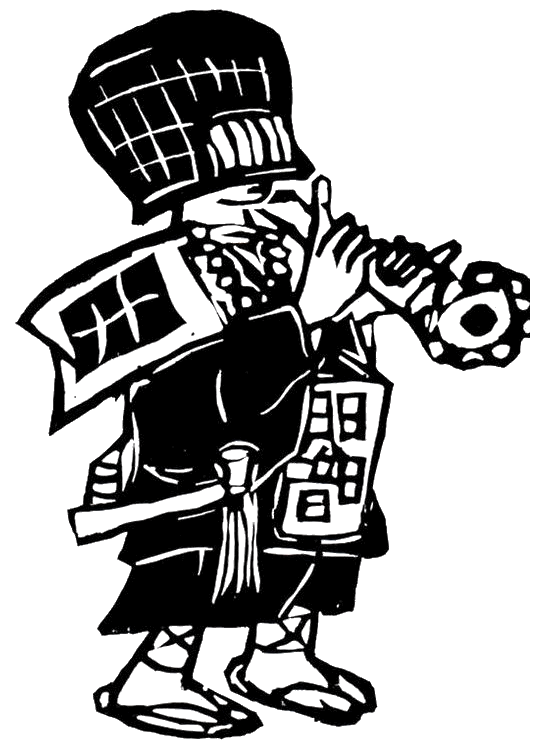
| Takuhatsu | 托鉢 | The practice of begging for alms by monks / pieces played by Komuso when begging. | |
| Tamane | 玉音 | Flutter tongue technique | |
| Tegoto | 手事 | Musical Interlude | |
| Tegotomono | 手事物 | Musical form with Tegoto | |
| Utaguchi | 唄口 | The sharp blowing edge of the shakuhachi | |
| Utsu | 打(つ) | Hit or strike | |
| Yuri | ユリ | Vibrato |