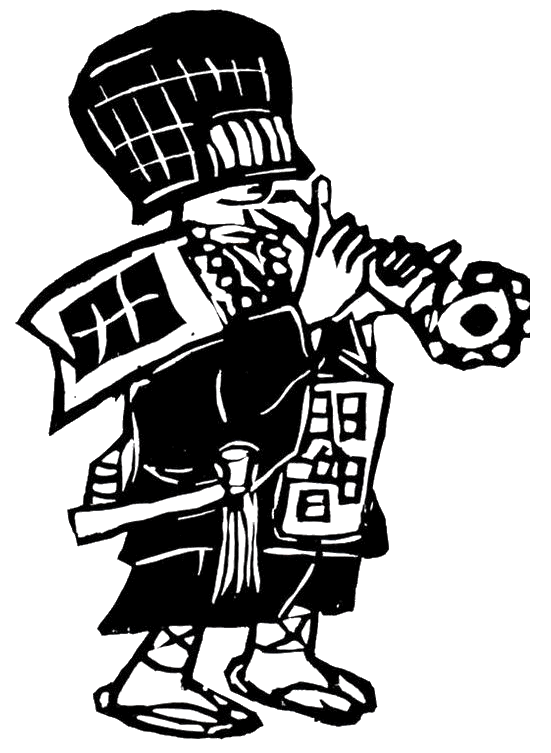
Kyūshū Reibo (Taizan Ha)
九州鈴慕
| [Genre] | Honkyoku |
History (Tokuyama Takashi):
| The southern island of Kyūshū is one on the founding places of koten honkyoku. Kyūshū-reibo is said to have come from Icchōken temple in Hakata. This temple, as well as the island of Kyūshū in general, was home to many komusō. During the Edo era, many wandering komusō would stay at these temples, exchanging different pieces and shakuhachi techniques. Gradually, a distinctive fingering technique developed that is now associated with the shakuhachi music that contains the word "reibo" in the title. Fukozenji was a monk of the temple of Ichyokenji. His duties included ringing the bell to announce different functions of the temple. It is said that Fukozenji composed Kyūshū-reibo by concentrating on the image or spirit of the temple bell. |
Kyūshū Reibo (Taizan Ha) appears on the following albums
| Album | Artist | |
| Hi Fu Mi |
Shakuhachi : Renkei Hashimoto | |
|
Yearning for the Bell (Kyushu version) In traditional shakuhachi music there are a number of different pieces with the title Reibo (Yearning for the Bell). This is a reference to the hand bell of legendary Chinese Zen master Fuke, who rang this bell in the 9th century when collecting alms. On the Southern island Kyushu there existed several komuso temples. Perhaps this piece comes from the Itchoken temple before it was then also played at other places. | ||
| Hi Kyoku |
Shakuhachi : Tokuyama Takashi | |
|
The southern island of Kyushu is one on the founding places of koten honkyoku. Kyushu-reibo is said to have come from Icchoken temple in Hakata. This temple, as well as the island of Kyushu in general, was home to many komuso. During the Edo era, many wandering komuso would stay at these temples, exchanging different pieces and shakuhachi techniques. Gradually, a distinctive fingering technique developed that is now associated with the shakuhachi music that contains the word "reibo" in the title. Fukozenji was a monk of the temple of Ichyokenji. His duties included ringing the bell to announce different functions of the temple. It is said that Fukozenji composed Kyushu-reibo by concentrating on the image or spirit of the temple bell.
| ||
| Ichion Jobutsu |
Shakuhachi : Matsumoto Kyozan | |
| Japanese Masterpieces for the Shakuhachi |
Shakuhachi : Yes Yes | |
|
Kyushu Reibo for solo shakuhachi is one of the religious pieces of music composed in memory of Buddha's death. Kyushu is the southernmost island of Japan. Being closest to China, the most ancient cultures prospered there and many shakuhachi masters went on pilgrimages there. Conceived by one of the pilgrims who visited there and impressed by the reibo (spirit) of Buddha. The shakuhachi used here is 2 ft. 1 in. long.
| ||
| Japanese Treasures |
Shakuhachi : Yes Yes | |
|
Kyushu Reibo for solo shakuhachi is one of the religious pieces of music composed in memory of Buddha's death. Kyushu is the southernmost island of Japan. Being closest to China, the most ancient cultures prospered there and many shakuhachi masters went on pilgrimages there. Conceived by one of the pilgrims who visited there and impressed by the reibo (spirit) of Buddha. The shakuhachi used here is 2 ft. l in. long.
| ||
| Koten Shakuhachi Gaku Zen Shū - 3 |
Shakuhachi : Takeuchi Shikō | |
| Meian Sōda (vol. 4 and 5) |
Shakuhachi : Sakaguchi Tetsushin | |
| Meianji Shoden Shakuhachi Honkyoku Shu 01 |
Shakuhachi : Yoshimura Sōshin Fuan | |
| Myoan Sanjunana Sei Tanikita Muchiku Shu - 1 |
Shakuhachi : Tanikita Muchiku Roan | |
| Standing Waves (CD) |
Shakuhachi : Torsten Olafsson | |
| Take no Shirabe; Fuke Shu Honkyoku |
Shakuhachi : Yes Yes | |